
How to Overcome Writer’s Block: From Essays to Dissertations
Since 2006, Oxbridge Essays has been the UK’s leading paid essay-writing and dissertation service
We have helped 10,000s of undergraduate, Masters and PhD students to maximise their grades in essays, dissertations, model-exam answers, applications and other materials.
If you would like a free chat about your project with one of our UK staff, then please just reach out on one of the methods below.
Ever opened a blank document, stared at it for far too long, and then quietly closed it again? Then you’ve already experienced writer’s block.
It’s something we see all the time. Students come to us convinced they’re the only ones struggling, when in reality, writer’s block is one of the most common challenges in academic life. It doesn’t matter whether you’re drafting your first undergraduate essay or refining a PhD thesis chapter—at some point, you'll find yourself stuck.
Understanding what writer’s block means in an academic context is the first step. It isn’t simply not feeling like writing. More often, it’s a mix of uncertainty, pressure, and overthinking that makes it difficult to begin or continue. And the longer it goes on, the more overwhelming it can feel.
The good news is that it’s entirely manageable. In our experience, once you understand what’s behind it, learning how to overcome writer’s block with a few actionable strategies becomes far more achievable.
What Writer’s Block Looks Like
In creative writing, writer’s block is often described as a lack of inspiration. In academia, it’s rarely that simple.
We’ve worked with students who have done extensive research, taken detailed notes, and fully understand their topic—yet still feel unable to write. That’s because block while writing often stems from structure, clarity, or pressure rather than ideas.
You might recognise it as:
- rewriting the same sentence repeatedly without making progress
- delaying writing because you “need to read one more source”
- struggling to start an introduction, even when you know the argument
- feeling stuck halfway through a section with no clear way forward
This is where writer’s block in academia differs. It’s not necessarily because you don’t know what to write, but because you’re experiencing difficulty translating your thinking into structured, formal writing.
What Causes Writer’s Block?
So what causes of writer's block? In reality, it’s rarely just one single thing. More often, it’s a combination of pressures that build up over time. For many students, writer’s block begins with pressure to get everything right before they’ve even started. From our experience working with students across different levels, a few key patterns come up again and again:
How Writer’s Block Changes Across Academic Levels
While writer’s block is common at every stage, it tends to show up differently depending on what type of assignment you’re working on.
Undergraduate Essays and Dissertations: Getting Started Feels Hardest
At undergraduate level, writer’s block is often tied to uncertainty. You are still developing your academic writing skills, and you’re probably not confident enough in structuring arguments.
We work with students who struggle most with:
- interpreting the essay question
- finding the right angle for a dissertation
- planning a clear structure
- writing introductions and literature reviews
Master's Dissertations: Too Much Information and Not Enough Direction
At Master’s level, the challenge shifts. Students usually have acquired stronger writing skills, but the scope of the work is much larger.
Writer’s block here often comes from difficulty synthesising large volumes of literature, uncertainty about how to position their argument and/or pressure to demonstrate originality.
So, chances are that you feel stuck because you have too much to say and aren’t sure how to organise it.
PhD Theses: Long-Term Pressure and Conceptual Fatigue
At PhD level, writer’s block becomes way more complex. This is where many students begin to ask seriously how to deal with writer's block in a more frequent and sustainable way. Doctoral writing is:
- long-term
- independent
- intellectually demanding
For these reasons, over time, it’s common to experience loss of momentum, difficulty maintaining structure across chapters and overall fatigue with the research topic itself.
Interestingly, many PhD students don’t struggle with ideas—they struggle with confidence in those ideas. The expectation to contribute something new to the field can make even strong work feel insufficient.
For many students, writer’s block begins with pressure to get everything right before they’ve even started.
How to Overcome Writer’s Block in Practice
Want to get over writer's block quickly? While there’s no single fix for this, there are approaches we’ve seen work consistently across different levels of study.
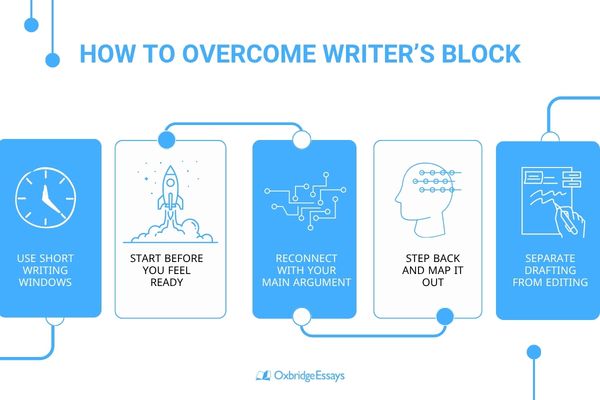
Start way before you feel ready
One of the biggest misconceptions about writing is that you need to feel prepared before you begin. In reality, clarity often emerges through writing, not before it. We’ve worked with many students who spend hours trying to “figure things out” in their heads, only to feel more stuck.
The turning point usually comes when they begin—however roughly. Even a few imperfect sentences can unlock your thinking. It doesn’t need to be polished; it just needs to exist.
Think smaller to move forward
Writer’s block tends to grow when the task feels too large. A full essay or dissertation chapter can seem overwhelming, but a paragraph can be manageable.
Instead of setting broad goals like I need to write 2,000 words, it’s often more effective to narrow your focus: I’ll write 150 words on this one idea.
This shift reduces pressure and helps you build momentum gradually. Progress, even in small amounts, is often enough to break the cycle.
Step back and map it out
Sometimes the issue isn’t writing in itself but not knowing how everything fits together.
If you find yourself stuck, it can help to pause and sketch out the structure instead. That might mean outlining your argument, jotting down key points, or simply listing what each section needs to do.
Once the direction is clearer, the writing tends to follow much more naturally. In many cases, this is one of the most effective ways to overcome writer’s block in academic work.
Let drafting and editing happen separately
Another pattern we see frequently is students trying to perfect each sentence as they write it. While that might feel productive, it often slows things down considerably. Writing and editing require different types of focus. Trying to do both at once can interrupt your flow and make progress feel frustratingly slow.
A more effective approach is to draft freely first, allowing ideas to develop. Leave everything as it is and then return later with a more critical eye. This separation often makes writing feel far less restrictive.
Create short, focused writing windows
If concentration is part of the challenge, it can help to introduce some structure to your writing time. For example, setting a timer for 20–25 minutes and committing to writing during that period—without editing and checking sources or looking at your phone!—can make the task feel more contained.
Over time, these short bursts can significantly reduce the feeling of being stuck and offer a practical way to deal with writer's block.
Reconnect with your main argument
If you’ve started writing but feel stuck part-way through, it’s often worth revisiting your research question or central argument.
Ask yourself:
What exactly am I trying to say in this section?
How does this connect to my overall aim?
Losing sight of your direction is a common cause of writer’s block, particularly in longer pieces of work. Even a small clarification can make the next steps much clearer.
Building Long-Term Writing Habits
While these strategies can help in the moment, learning how to overcome writer’s block in a lasting way often comes down to habit.
From what we’ve observed, students who struggle less with writer’s block tend to approach writing as an ongoing process rather than something left until the final stages. They write regularly, even if it’s only in small amounts, and they’re more willing to seek feedback before everything feels “finished”.
Perhaps most importantly, they see writing as part of their thinking—not just a way of presenting ideas, but a way of developing them.
Can AI Help with Writer’s Block?
This is something students increasingly ask us and worry about—and understandably so. If you’re dealing with writer’s block, using an AI tool to get you unstuck can feel like an obvious solution. A quick prompt, and suddenly you have a structure, an introduction, or even a full draft in front of you.
In our experience, AI can be genuinely helpful when you’re experiencing some sort of block when writing an assignment, particularly for:
- generating initial ideas
- clarifying a structure
- rephrasing a sentence you can’t quite get right
Used this way, it acts more like a sounding board than a substitute. It can help you move past that initial hesitation and start writing again, which is often the hardest part when you’re trying to figure out how to get over writer's block.
Where AI Can Cause Problems
Where things become more complicated is when AI starts doing the thinking for you.
Submitting AI-generated content as your own isn’t just risky—it can undermine the very skills your degree is designed to develop. At the end of the day, Academic writing is about learning how to think critically, build arguments, and express ideas clearly.
There’s also a practical issue. AI-generated text can sound convincing, but it isn’t always accurate, and it doesn’t reflect your individual academic voice. Over-reliance on it can actually make writer’s block worse over time, because it prevents you from building confidence in your own writing process.
Our Take: Use AI as a Tool, Not a Shortcut
We’re not against AI. In fact, we recognise that it’s becoming part of academic life. But the distinction we always emphasise is simple:
- AI can support your writing process
- It shouldn’t replace your thinking or authorship
If you’re using it to get past a moment where you feel stuck while writing, that’s one thing. But your final work should always reflect your own understanding, structure, and argument. This is one of the most important ways to deal with writer's block in a way that actually strengthens your academic skills rather than weakening them.
A Note on AI and Humanising Your Writing
One issue we’re increasingly seeing is students relying heavily on AI-generated drafts, then worrying about how those drafts will be perceived—by markers or by AI detection tools. That’s where careful revision becomes essential.
At Oxbridge Essays, we offer a dedicated AI humanising service, where expert academics work with your text to:
- refine clarity and structure
- ensure it reflects a natural academic voice
- maintain originality and integrity
The final goal is to ensure your work reads as thoughtful, coherent, and genuinely your own.
Writer’s Block Not Going Away? It Might Be Time to Ask for Help
Experiencing writer’s block from time to time is part of academic writing. But when it lingers—when days turn into weeks—it’s often a sign that something deeper is holding you back.
In our experience, prolonged writer’s block is rarely about a lack of ability. More often, it reflects underlying uncertainty: perhaps your structure isn’t quite working, your argument feels unclear, or you’re unsure what’s actually expected of you. When those foundations aren’t fully in place, writing can feel far more difficult than it should.
At that point, trying to push through on your own isn’t always the most effective approach. Sometimes, what makes the difference is stepping outside your own perspective. Talking through your ideas, getting constructive feedback, or working with someone who understands academic writing can help you regain clarity—and with it, the confidence to move forward.
Frequently Asked Questions
How do writers overcome writer's block?
Most writers overcome writer’s block by changing how they approach writing. This often involves starting with rough drafts, breaking work into smaller tasks, and focusing on progress rather than perfection. In academic contexts, clarity of structure and argument also plays a key role.
What causes writer's block?
Writer’s block is typically caused by a combination of factors, including perfectionism, lack of clarity, overwhelm, and self-doubt. In academia, it’s often linked to uncertainty about structure or pressure to meet high expectations.
What is the fastest way to cure writer's block?
There’s no instant cure, but one of the fastest ways to get past writer’s block is to start writing without even thinking about editing. Even a short, imperfect paragraph can help break the cycle and restore momentum.
Do all writers get writer's block?
Yes—at some point, almost all writers experience writer’s block, both outside and inside academia. This includes undergraduate students, postgraduates, and even experienced academics. The key difference is how they respond to it.